
What is inside these Metals and Non-metals notes
These notes follow the board textbook chapter “Metals and Non-metals”. Each page has one big idea, with colour cards so you can revise fast.
- Physical properties of metals and non-metals (3.1)
- Chemical properties of metals (3.2)
- How do metals and non-metals react? Ionic compounds (3.3)
- Occurrence and extraction of metals (3.4)
- Corrosion, prevention and alloys (3.5)
Also in the PDF
- Cover and chapter map: every topic with its page number, a concept diagram and what to know before you start.
- Reactivity series and displacement reactions
- Electron transfer in NaCl, MgCl₂ and other ionic compounds
- Steps in extracting metals from ores
- Common mistakes and tips on each topic page.
- Quick-revision page: every formula and rule of the chapter on one sheet.
- Last-day checklist with answer-writing templates and a 5-minute plan.
- Practice questions with an answer key so you can check yourself.
Preview the notes
Tap a page to enlarge it. Use “Read online” or “Download PDF” at the top for the full notes.


Liked this chapter? Get every chapter in one book.
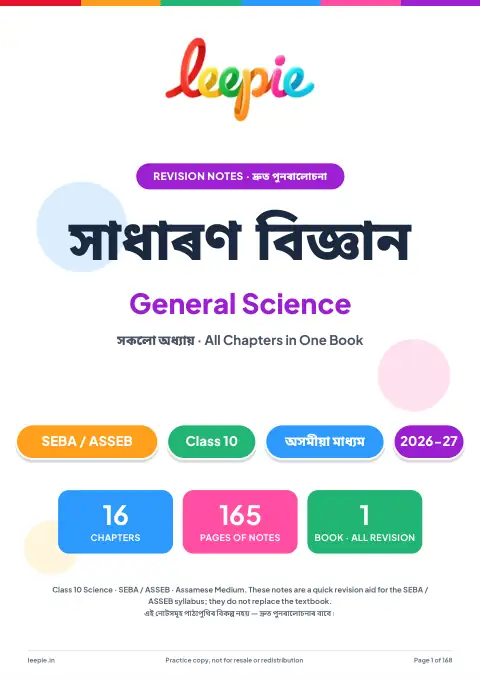
Complete General Science revision notes: 168 pages with formulas, worked examples, quick-revision pages and practice questions with answers. Read the first pages free.
Practise after you revise
Metals and Non-metals: MCQs with answers
Free sample MCQs in Assamese, with an explanation for every answer. Chapter numbers on the MCQ pages follow the Leepie app and can differ from the textbook.
Practise Metals and Non-metals MCQsHow to use these notes
- Read the chapter map and the “before you start” cards.
- Study one topic page at a time, then cover the worked example and solve it yourself.
- Revise from the quick-revision page every day in the last week.
- Finish with the practice questions and check your answers against the answer key.
Frequently Asked Questions
Are these revision notes free?
Yes. Chapters 1 to 3 of each Class 10 subject are free to read online and download, with no sign-up. All chapters together are sold as one complete revision notes book in the Leepie store.
Which language are the notes in?
The notes are written in Assamese, for students of the Assam board (SEBA / ASSEB). Chapter names also carry the English name, for example “Metals and Non-metals”.
Is this an official SEBA or textbook publication?
No. Leepie’s revision notes are an independent study aid made to go with the textbook. Always read your textbook and follow your teacher’s guidance.
How should I use these notes?
Read the colour cards once, solve the worked examples yourself, then use the quick-revision page and the last-day checklist before the exam. Finish with the practice questions and check your answers.